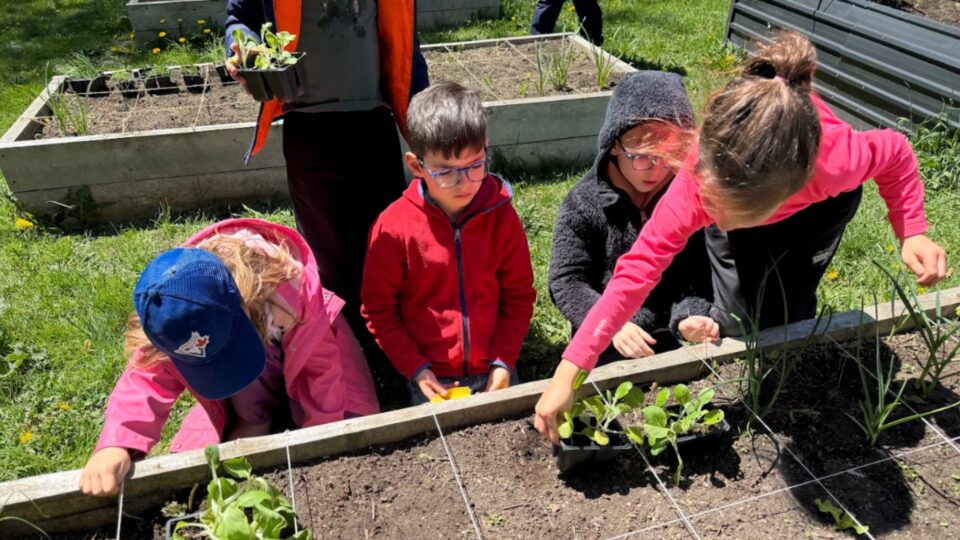
What happens to a school garden when the students who planted it head home for summer?
At St. Monica, it keeps growing.
The tiny seedlings planted by Grade 1 students last spring became zucchini, cucumbers, tomatoes, Swiss chard, eggplant and carrots. But the best part of this harvest isn’t what grew. It’s where some of it went.
Throughout the summer, vegetables from St. Monica’s garden were shared with Ottawa food banks, turning a classroom learning experience into something that could help families in the community.
A few raised garden beds have become much more than a place to grow vegetables. They are a living classroom where students can wonder, experiment, collaborate and discover something pretty remarkable: when you care for something and help it grow, you may end up nourishing far more than you expected.
Learning From the Ground Up
St. Monica’s garden began with Growing Up Organic, a program that helped students build three raised garden beds and taught them about native plants and gardening. With two additional beds purchased by the school’s Parent Council, the garden has continued to grow alongside the school’s outdoor learning program.
This past spring, Grade 1 students, with support from a Grade 2 class, grew seedlings and planted them in the garden. For teacher Anita Badoux, it was a natural way to take learning outside the classroom. Students explored what living things need to survive, including water, air, light, nutrients and space. Instead of simply reading about the life cycle of a plant, they experienced it themselves.
They watered. They weeded. They watched.
Students kept journals, recorded their observations and measured plants to track their growth. They worked together to plan the garden beds and even explored companion planting, considering which plants might make good “neighbours.”
There was plenty of curiosity, collaboration and problem-solving along the way.
A Classroom for All the Senses
The garden gave students plenty of opportunities to get their hands dirty, but the learning didn’t stop there. Students smelled and tasted lettuce and herbs, and used mortars and pestles to explore some of the plants through their senses. In June, they even turned part of their harvest into nutritious salads to enjoy together.
For these young learners, the experience made their learning tangible. A plant wasn’t just something on a page. It was something they had measured, smelled, tasted and helped keep alive.
When School Ends, the Garden Keeps Growing
Of course, gardens don’t follow the school calendar.
When students headed home for the summer, Anita and a parent volunteer continued caring for the beds, returning to the school to water, weed and harvest what the students had planted.
That’s where St. Monica’s connection to Veggie Share Ottawa gave the garden an even greater purpose.
The volunteer-run initiative, coordinated by retired educator Roseanne Popp, brings together school gardens, families and community volunteers to collect fresh produce for Ottawa food banks.
St. Monica participates alongside St. Veronica and St. Mary schools. Throughout the summer, produce harvested from the school gardens joins surplus vegetables donated by community members before making its way to families who can use it.
For Anita, seeing something students started in the spring continue to make a difference throughout the summer has been particularly rewarding.
“I love that the students can see that the vegetables they are helping to grow can actually help someone else.”
Growing Something to Share
That simple connection has opened the door to conversations that go well beyond gardening.
Students talked about how not everyone has the same access to fresh produce and what it means to share something you have with someone who needs it. The vegetables may be small but the lesson isn’t.
It’s also Deep Learning in action. Students collaborate, solve problems, ask questions, observe the world around them and see that their choices can have an impact beyond their classroom.
And at the heart of the project is something deeply connected to our Catholic faith: caring for creation, serving others and recognizing that what we have can be shared.
Nourishing More Than a Garden
Now that students are back at St. Monica, the garden is ready for a new group of learners.
The zucchini, cucumbers, tomatoes, Swiss chard, eggplant, and carrots still growing this fall offer another class the chance to explore what students started months earlier.
There is something wonderfully simple about that.
One group of students planted. Others cared for what they left behind. Families in the community benefited from what grew. And now another group of students gets to continue the learning.
At St. Monica, Nourish New Beginnings isn’t simply this year’s spiritual theme. You can see it growing right outside the school.
Sometimes a new beginning really does start with something as small as a seed.


