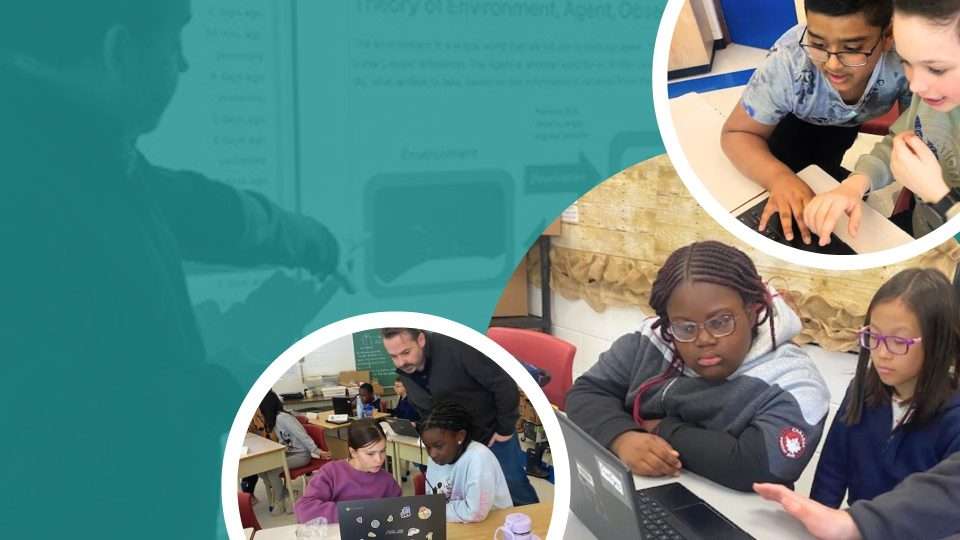
Students in the OCSB’s Program for Gifted Learners (PGL) are blasting off into the future—and this time, artificial intelligence is riding shotgun!
Combining brainpower and innovation, students from St. Brother André School—guided by PGL teacher Deborah Quail-Blier— have partnered with Ottawa-based tech company MindBridge AI and its Chief Technology Officer, Robin Grosset, to dive deep into the world of AI—learning how to build it, train it, and put it to the test.
Can AI Survive Space?
Their ambitious mission? To launch their AI experiment into space aboard a NASA rocket and a high-altitude research balloon through the globally recognized Cubes in Space program. This year, the project will put student-designed technology in orbit to determine how cosmic radiation might impact AI performance—literally taking learning to the atmosphere’s edge.
Working side-by-side with Robin, a leading AI expert, students developed and tested multiple AI models, ultimately selecting the top-performing one. This model will now be transferred onto computer memory chips—24 in total for each spaceflight platform. These chips are small, but mighty; they must fit into a cube just 4x4x4 cm in size, meeting the strict criteria for the program.
So what inspired Robin to collaborate with our students on this unique journey?
“I’ve spent my career exploring how science and engineering shape the world, and I often wish I’d been exposed to those ideas much earlier,” he shared. “I saw a chance to give students the sort of hands-on, ‘a-ha!’ moments I missed. Their project hits the sweet spot of being technically challenging while also being a lot of fun!”
Building on a Legacy of Innovation
This isn’t the first time PGL students have made their mark beyond Earth’s atmosphere. In 2022, over 150 students collaborated on two successful experiments that were also selected for launch. In 2025, students are pushing the boundaries even further, bringing AI into the equation.
Of course, communicating complex AI principles to students isn’t always straightforward. But Robin has developed his own style of making tough concepts click.
“It helps to bring analogies,” he explained. “We learned about something called reinforcement learning, which we can relate back to training a dog with rewards. When our AI does better, we reward it, just like we would reward a dog for good behaviour. After spending a little time on theory, there is always a hands-on element. Learning by doing allows the students to experiment and to watch how the AI learns.”
Learning, Wonder, and Discovery—Together
Robin noted that some of the most exciting parts of the project were the surprises along the way.
“Sometimes I am learning right alongside the students,” he said. “In almost every class, there is a moment where I ask a question, and the answer from the student is so insightful. It’s one of the many reasons why I love teaching these classes.
But also, this is a genuine experiment: We are sending AI into space. The experiment design: How do we think about cosmic radiation, and what could happen? It’s fascinating. And listening to the class hypothesize about this, you can see the students are really engaged and thinking.”
The experiment’s acceptance into this year’s mission is a proud moment, but it’s far from the end. Students will present their work and findings at FlightFest, held June 27–29, 2025 at the Canada Aviation and Space Museum, where they’ll join peers, educators, and experts in celebrating innovation, creativity, and the spirit of discovery.
Deep Learning in Action
This project embodies the OCSB’s Deep Learning approach, where students are not just memorizing facts but developing essential global competencies. As students tackle real-world, advanced challenges, they build the skills that will prepare them for careers that may not even exist yet. Projects like this also reflect the core values of the Program for Gifted Learners (PGL): Be Community. Be Innovative.
Robin encourages other professionals to get involved in similar ways:
“What drew me to being a scientist and engineer was a sense of wonder and curiosity at the world. I try to show that same excitement to the students and reflect that in the experiment and the technology we are using. I think what the students are accomplishing is amazing, and I feel that being a part of this is a privilege.
I also try to model lifelong learning. Admitting that I don’t know everything but that we can figure it out together. This is all about encouraging and engaging the minds of our future.”
Through hands-on, inquiry-driven learning, students are honing their technical skills and becoming thoughtful researchers and problem-solvers, ready to engage with the world around and above them.
Stay tuned as our students prepare for liftoff! You can follow the progress of the group’s experiments on Twitter/X by following @PGLSBA 🚀✨


